10 Tips For The Successful Long-Term Investor
While it may be true that in the stock market there is no rule without an exception, there are some principles that are tough to dispute. Let's review 10 general principles to help investors get a better grasp of how to approach the market from a long-term view. Every point embodies some fundamental concept every investor should know.
1. Sell the losers and let the winners ride!Time and time again, investors take profits by selling their appreciated investments, but they hold onto stocks that have declined in the hope of a rebound. If an investor doesn't know when it's time to let go of hopeless stocks, he or she can, in the worst-case scenario, see the stock sink to the point where it is almost worthless. Of course, the idea of holding onto high-quality investments while selling the poor ones is great in theory, but hard to put into practice. The following information might help:
2. Don't chase a "hot tip".Whether the tip comes from your brother, your cousin, your neighbor or even your broker, you shouldn't accept it as law. When you make an investment, it's important you know the reasons for doing so; do your own research and analysis of any company before you even consider investing your hard-earned money. Relying on a tidbit of information from someone else is not only an attempt at taking the easy way out, it's also a type of gambling. Sure, with some luck, tips sometimes pan out. But they will never make you an informed investor, which is what you need to be to be successful in the long run. (Find what you should pay attention to - and what you should ignore in Listen To The Markets, Not Its Pundits.)
3. Don't sweat the small stuff.As a long-term investor, you shouldn't panic when your investments experience short-term movements. When tracking the activities of your investments, you should look at the big picture. Remember to be confident in the quality of your investments rather than nervous about the inevitable volatility of the short term. Also, don't overemphasize the few cents difference you might save from using a limit versus market order.
Granted, active traders will use these day-to-day and even minute-to-minute fluctuations as a way to make gains. But the gains of a long-term investor come from a completely different market movement - the one that occurs over many years - so keep your focus on developing your overall investment philosophy by educating yourself. (Learn the difference between passive investing and apathy in Ostrich Approach To Investing A Bird-Brained Idea.)
4. Don't overemphasize the P/E ratio.Investors often place too much importance on the price-earnings ratio (P/E ratio). Because it is one key tool among many, using only this ratio to make buy or sell decisions is dangerous and ill-advised. The P/E ratio must be interpreted within a context, and it should be used in conjunction with other analytical processes. So, a low P/E ratio doesn't necessarily mean a security is undervalued, nor does a high P/E ratio necessarily mean a company is overvalued. (For further reading, see our tutorial Understanding the P/E Ratio.)
5. Resist the lure of penny stocks.A common misconception is that there is less to lose in buying a low-priced stock. But whether you buy a $5 stock that plunges to $0 or a $75 stock that does the same, either way you've lost 100% of your initial investment. A lousy $5 company has just as muchdownside risk as a lousy $75 company. In fact, a penny stock is probably riskier than a company with a higher share price, which would have more regulations placed on it. (For further reading, see The Lowdown on Penny Stocks.)
6. Pick a strategy and stick with it.Different people use different methods to pick stocks and fulfill investing goals. There are many ways to be successful and no one strategy is inherently better than any other. However, once you find your style, stick with it. An investor who flounders between different stock-picking strategies will probably experience the worst, rather than the best, of each. Constantly switching strategies effectively makes you a market timer, and this is definitely territory most investors should avoid. Take Warren Buffett's actions during the dotcom boom of the late '90s as an example. Buffett's value-oriented strategy had worked for him for decades, and - despite criticism from the media - it prevented him from getting sucked into tech startups that had no earnings and eventually crashed. (Want to adopt the Oracle of Omaha's investing style? See Think Like Warren Buffett.)
7. Focus on the future.The tough part about investing is that we are trying to make informed decisions based on things that have yet to happen. It's important to keep in mind that even though we use past data as an indication of things to come, it's what happens in the future that matters most.
A quote from Peter Lynch's book "One Up on Wall Street" (1990) about his experience with Subaru demonstrates this: "If I'd bothered to ask myself, 'How can this stock go any higher?' I would have never bought Subaru after it already went up twentyfold. But I checked thefundamentals, realized that Subaru was still cheap, bought the stock, and made sevenfold after that." The point is to base a decision on future potential rather than on what has already happened in the past. (For more insight, see The Value Investor's Handbook.)
8. Adopt a long-term perspective.Large short-term profits can often entice those who are new to the market. But adopting a long-term horizon and dismissing the "get in, get out and make a killing" mentality is a must for any investor. This doesn't mean that it's impossible to make money by actively trading in the short term. But, as we already mentioned, investing and trading are very different ways of making gains from the market. Trading involves very different risks that buy-and-holdinvestors don't experience. As such, active trading requires certain specialized skills.
Neither investing style is necessarily better than the other - both have their pros and cons. But active trading can be wrong for someone without the appropriate time, financial resources, education and desire. (For further reading, see Defining Active Trading.)
9. Be open-minded.Many great companies are household names, but many good investments are not household names. Thousands of smaller companies have the potential to turn into the large blue chipsof tomorrow. In fact, historically, small-caps have had greater returns than large-caps; over the decades from 1926-2001, small-cap stocks in theU.S.
This is not to suggest that you should devote your entire portfolio to small-cap stocks. Rather, understand that there are many great companies beyond those in the Dow Jones Industrial Average (DJIA), and that by neglecting all these lesser-known companies, you could also be neglecting some of the biggest gains. (For more on investing in small caps, see Small Caps Boast Big Advantages.)
10. Be concerned about taxes, but don't worry.Putting taxes above all else is a dangerous strategy, as it can often cause investors to make poor, misguided decisions. Yes, tax implications are important, but they are a secondary concern. The primary goals in investing are to grow and secure your money. You should always attempt to minimize the amount of tax you pay and maximize your after-tax return, but the situations are rare where you'll want to put tax considerations above all else when making an investment decision (see Basic Investment Objectives).
Conclusion
There are exceptions to every rule, but we hope that these solid tips for long-term investors and the common-sense principles we've discussed benefit you overall and provide some insight into how you should think about investing.
1. Sell the losers and let the winners ride!Time and time again, investors take profits by selling their appreciated investments, but they hold onto stocks that have declined in the hope of a rebound. If an investor doesn't know when it's time to let go of hopeless stocks, he or she can, in the worst-case scenario, see the stock sink to the point where it is almost worthless. Of course, the idea of holding onto high-quality investments while selling the poor ones is great in theory, but hard to put into practice. The following information might help:
- Riding a Winner - Peter Lynch was famous for talking about "tenbaggers", or investments that increased tenfold in value. The theory is that much of his overall success was due to a small number of stocks in his portfolio that returned big. If you have a personal policy to sell after a stock has increased by a certain multiple - say three, for instance - you may never fully ride out a winner. No one in the history of investing with a "sell-after-I-have-tripled-my-money" mentality has ever had a tenbagger. Don't underestimate a stock that is performing well by sticking to some rigid personal rule - if you don't have a good understanding of the potential of your investments, your personal rules may end up being arbitrary and too limiting. (For more insight, see Pick Stocks Like Peter Lynch.)
- Selling a Loser - There is no guarantee that a stock will bounce back after a protracted decline. While it's important not to underestimate good stocks, it's equally important to be realistic about investments that are performing badly. Recognizing your losers is hard because it's also an acknowledgment of your mistake. But it's important to be honest when you realize that a stock is not performing as well as you expected it to. Don't be afraid to swallow your pride and move on before your losses become even greater.
2. Don't chase a "hot tip".Whether the tip comes from your brother, your cousin, your neighbor or even your broker, you shouldn't accept it as law. When you make an investment, it's important you know the reasons for doing so; do your own research and analysis of any company before you even consider investing your hard-earned money. Relying on a tidbit of information from someone else is not only an attempt at taking the easy way out, it's also a type of gambling. Sure, with some luck, tips sometimes pan out. But they will never make you an informed investor, which is what you need to be to be successful in the long run. (Find what you should pay attention to - and what you should ignore in Listen To The Markets, Not Its Pundits.)
3. Don't sweat the small stuff.As a long-term investor, you shouldn't panic when your investments experience short-term movements. When tracking the activities of your investments, you should look at the big picture. Remember to be confident in the quality of your investments rather than nervous about the inevitable volatility of the short term. Also, don't overemphasize the few cents difference you might save from using a limit versus market order.
Granted, active traders will use these day-to-day and even minute-to-minute fluctuations as a way to make gains. But the gains of a long-term investor come from a completely different market movement - the one that occurs over many years - so keep your focus on developing your overall investment philosophy by educating yourself. (Learn the difference between passive investing and apathy in Ostrich Approach To Investing A Bird-Brained Idea.)
4. Don't overemphasize the P/E ratio.Investors often place too much importance on the price-earnings ratio (P/E ratio). Because it is one key tool among many, using only this ratio to make buy or sell decisions is dangerous and ill-advised. The P/E ratio must be interpreted within a context, and it should be used in conjunction with other analytical processes. So, a low P/E ratio doesn't necessarily mean a security is undervalued, nor does a high P/E ratio necessarily mean a company is overvalued. (For further reading, see our tutorial Understanding the P/E Ratio.)
5. Resist the lure of penny stocks.A common misconception is that there is less to lose in buying a low-priced stock. But whether you buy a $5 stock that plunges to $0 or a $75 stock that does the same, either way you've lost 100% of your initial investment. A lousy $5 company has just as muchdownside risk as a lousy $75 company. In fact, a penny stock is probably riskier than a company with a higher share price, which would have more regulations placed on it. (For further reading, see The Lowdown on Penny Stocks.)
6. Pick a strategy and stick with it.Different people use different methods to pick stocks and fulfill investing goals. There are many ways to be successful and no one strategy is inherently better than any other. However, once you find your style, stick with it. An investor who flounders between different stock-picking strategies will probably experience the worst, rather than the best, of each. Constantly switching strategies effectively makes you a market timer, and this is definitely territory most investors should avoid. Take Warren Buffett's actions during the dotcom boom of the late '90s as an example. Buffett's value-oriented strategy had worked for him for decades, and - despite criticism from the media - it prevented him from getting sucked into tech startups that had no earnings and eventually crashed. (Want to adopt the Oracle of Omaha's investing style? See Think Like Warren Buffett.)
7. Focus on the future.The tough part about investing is that we are trying to make informed decisions based on things that have yet to happen. It's important to keep in mind that even though we use past data as an indication of things to come, it's what happens in the future that matters most.
A quote from Peter Lynch's book "One Up on Wall Street" (1990) about his experience with Subaru demonstrates this: "If I'd bothered to ask myself, 'How can this stock go any higher?' I would have never bought Subaru after it already went up twentyfold. But I checked thefundamentals, realized that Subaru was still cheap, bought the stock, and made sevenfold after that." The point is to base a decision on future potential rather than on what has already happened in the past. (For more insight, see The Value Investor's Handbook.)
8. Adopt a long-term perspective.Large short-term profits can often entice those who are new to the market. But adopting a long-term horizon and dismissing the "get in, get out and make a killing" mentality is a must for any investor. This doesn't mean that it's impossible to make money by actively trading in the short term. But, as we already mentioned, investing and trading are very different ways of making gains from the market. Trading involves very different risks that buy-and-holdinvestors don't experience. As such, active trading requires certain specialized skills.
Neither investing style is necessarily better than the other - both have their pros and cons. But active trading can be wrong for someone without the appropriate time, financial resources, education and desire. (For further reading, see Defining Active Trading.)
9. Be open-minded.Many great companies are household names, but many good investments are not household names. Thousands of smaller companies have the potential to turn into the large blue chipsof tomorrow. In fact, historically, small-caps have had greater returns than large-caps; over the decades from 1926-2001, small-cap stocks in the
This is not to suggest that you should devote your entire portfolio to small-cap stocks. Rather, understand that there are many great companies beyond those in the Dow Jones Industrial Average (DJIA), and that by neglecting all these lesser-known companies, you could also be neglecting some of the biggest gains. (For more on investing in small caps, see Small Caps Boast Big Advantages.)
10. Be concerned about taxes, but don't worry.Putting taxes above all else is a dangerous strategy, as it can often cause investors to make poor, misguided decisions. Yes, tax implications are important, but they are a secondary concern. The primary goals in investing are to grow and secure your money. You should always attempt to minimize the amount of tax you pay and maximize your after-tax return, but the situations are rare where you'll want to put tax considerations above all else when making an investment decision (see Basic Investment Objectives).
Conclusion
There are exceptions to every rule, but we hope that these solid tips for long-term investors and the common-sense principles we've discussed benefit you overall and provide some insight into how you should think about investing.
Buy and Hold Investing: Dead or Still Very Much Alive?
In the midst of the so-called “lost decade” (article) pundits continue to talk about the death of “buy and hold” (B&H) investing. I guess it probably makes sense to define B&H first before discussing it, but like most of amorphous financial concepts, there is no clear cut definition. According to some strict B&H interpreters, B&H means buy and hold forever (i.e., buy today and carry to your grave). For other more forgiving Wall Street lexicon analysts, B&H could mean a multi-year timeframe. However, with the advent of high frequency trading (HFT) and supercomputers, the speed of trading has only accelerated further to milliseconds, microseconds, and even nanoseconds. Pretty soon B&H will be considered buying a stock and holding it for a day! Average mutual fund turnover (holding periods) has already declined from about 6 years in the 1950s to about 11 months in the 2000s according to John Bogle.
Technology and the lower costs associated with trading advancements is obviously a key driver to shortened investment horizons, but even after these developments, professionals success in beating the market is less clear. Passive gurus Burton Malkiel and John Bogle have consistently asserted that 75% or more of professional money managers underperform benchmarks and passive investment vehicles (e.g., index funds and exchange traded funds).
This is not the first time that B&H has been held for dead. For example,BusinessWeek ran an article in August 1979 entitled The Death of Equities (see Magazine Cover article), which aimed to eradicate any stock market believers off the face of the planet. Sure enough, just a few years later, the market went on to advance on one of the greatest, if not the greatest, multi-decade bull market runs in history. People repudiated themselves from B&H back then, and while B&H was in vogue during the 1980s and 1990s it is back to being the whipping boy again today.
Excuse Me, But What About Bonds?
With all this talk about the demise of B&H and the rise of the HFT machines, I can’t help but wonder why B&H is dead in equities but alive and screaming in the bond market? Am I not mistaken, but has this not been the largest (or darn near largest) thirty year bull market in bonds? The Federal Funds Rate has gone from 20% in 1981 to 0% thirty years later. Not a bad period to buy and hold, but I’m going to go out on a limb and say the Fed Funds won’t go from 0% to a negative -20% over the next thirty years.
Better Looking Corpse
There’s no denying the fact that equities have been a lousy place to be for the last ten years, and I have no clue what stocks will do for the next twelve months, but what I do know is that stocks offer a completely different value proposition today. At the beginning of the 2000, the market P/E (Price Earnings) valued earnings at a 29x multiple with the 10-year Treasury Note trading with a yield of about 6%. Today, the market trades at 13.5 x’s 2010 earnings estimates (12x’s 2011) and the 10-Year is trading at a level less than half the 2000 rate (2.75% today). Maybe stocks go nowhere for a while, but it’s difficult to dispute now that equities are at least much more attractive (less ugly) than the prices ten years ago. If B&H is dead, at least the corpse is looking a little better now.
As is usually the case, most generalizations are too simplistic in making a point. So in fully reviewing B&H, perhaps it’s not a bad idea to clarify the two core beliefs underpinning the diehard buy and holders:
1) Buying and holding stocks is only wise if you are buying and holdinggood stocks.
2) Buying and holding stocks is not wise if you are buying and holdingbad stocks.
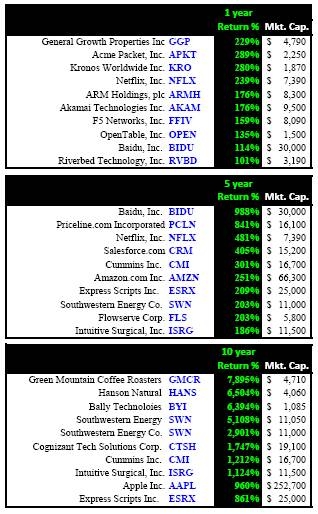
Even in the face of a disastrous market environment, here are a few stocks that have met B&H rule #1(click to enlarge):
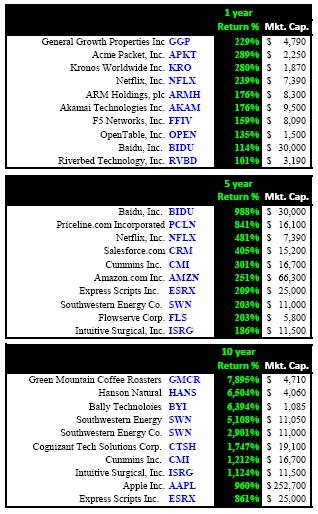
Maybe buy and hold is not dead after all? Certainly there have been plenty of stinking losing stocks to offset these winners. Regardless of the environment, if proper homework is completed, there is plenty of room to profitably resurrect stocks that are left for a buy and hold death by the so-called pundits.
